Territorial Flowers of Northern Canada: Symbols of Arctic Resilience
Figuring out exactly which plants survive the brutal Arctic winters isn’t just trivia; it’s a masterclass in biological survival. When examining the territorial flowers of Northern Canada, you’re looking at species engineered for extremes. How do these fragile-looking blooms withstand winds at -40°C and incredibly nutrient-starved soil? The answer lies in highly specialized adaptations, ranging from AFP (antifreeze proteins) to solar-tracking petals. Understanding the territorial flowers of Northern Canada means examining how life clings to the rocks at the very edge of the habitable world. We’ll look at the exact mechanisms these plants use to thrive where most vegetation instantly perishes.
- Territorial flowers of Northern Canada are not merely decorative species, but high-precision biological survival mechanisms.
- Arctic flora replaces biomass height with the molecular density of dehydrins and antifreeze proteins (AFP).
- The life cycle of Fireweed is dictated by 45°C thermal seed activation rather than seasonal transitions.
The Gateway to the North: Yukon’s Floral Emblem
Before we analyze the specific biology of the yukon territorial flower, we must understand the subarctic environment it dominates. The western territory’s environment faces wild temperature swings, ranging from 30°C in July down to -50°C in January, alongside frequent summer wildfires. The plant representing this region doesn’t just survive these infernos; it actively requires them to germinate.
Yukon Territorial Flower: The Vibrant Fireweed (Chamaenerion angustifolium)
The Yukon territorial flower transforms post-fire char into nitrogen-rich zones through symbiosis with arbuscular mycorrhizae.
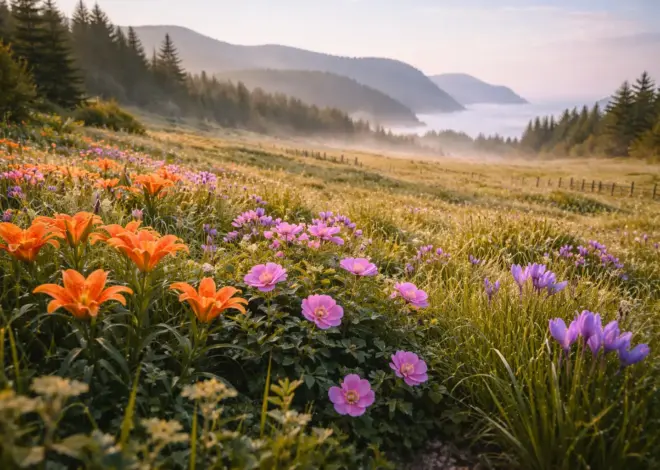
It features tall, intensely pink spikes that grow between 0.5 and 2.5 meters in height. Unlike delicate greenhouse orchids, the fireweed Yukon relies on sheer volume, producing up to 80,000 microscopic seeds per plant. Wind carries these seeds across vast distances, allowing the species to rapidly colonize disturbed soils.
This aggressive growth strategy is highly effective for rapid soil stabilization if the environment is at an early post-fire succession stage. However, in the context of mature, unburned boreal forests with dense canopy shading, this may not work because the seeds require direct sunlight to break dormancy.
The Role of Soil Mycorrhizae in Post-Fire Recovery
To maximize nutrient uptake in depleted ash, the yukon territorial flower forms symbiotic bonds with arbuscular mycorrhizal fungi. These fungi extend the root system’s reach, mining phosphorus that would otherwise be inaccessible. This underground network is the “hidden engine” behind the sea of pink seen across the territory.
Natural Regeneration: Why Fireweed Thrives After Forest Fires
Why do these pink fields appear out of nowhere after a devastating blaze? Fire clears out the thick moss layer, exposing mineral soil and temporarily spiking nitrogen levels.
“Fireweed doesn’t just tolerate a scorched earth; it capitalizes on the temporary lack of competition to monopolize the newly available nutrients.” — Dr. Susan Aiken, Former Research Scientist, Botany
The evolution of Fireweed marks a transition from passive seed dormancy to aggressive rhizomatic colonization.
According to the Yukon Government Department of Environment (2024, Whitehorse, Canada), fireweed regeneration typically covers 70% to 85% of burned ground within 2 to 3 years post-fire.
To understand how the yukon territorial flower achieves this, look at its primary regeneration traits:
- Thermal Seed Activation: Seeds remain dormant in the soil bank for 3 to 5 years, activating only when soil surface temperatures exceed 45°C during a fire.
- Rhizome Expansion: Below the surface, creeping rootstalks spread laterally by 1 to 2 meters per season, bypassing the need for seed germination in established patches.
- Alkaline Tolerance: Wood ash spikes the soil pH to levels between 7.5 and 8.5, which kills off competing vegetation but provides the ideal chemistry for fireweed roots.
Where to Witness the Sea of Pink in Yukon’s Subarctic Landscapes
You can’t just drive up any highway and expect a postcard view. The blooming window is incredibly specific. For the best chance to see the yukon territorial flower en masse, you need to visit burn scars along the Klondike Highway. The prime viewing window spans from late July to mid-August. You’ll typically find the densest concentrations at elevations between 500 and 1,200 meters. Go higher than 1,500 meters, and the temperature drops disrupt the flowering cycle.
The Tundra Bloom: Northwest Territories and the High Arctic
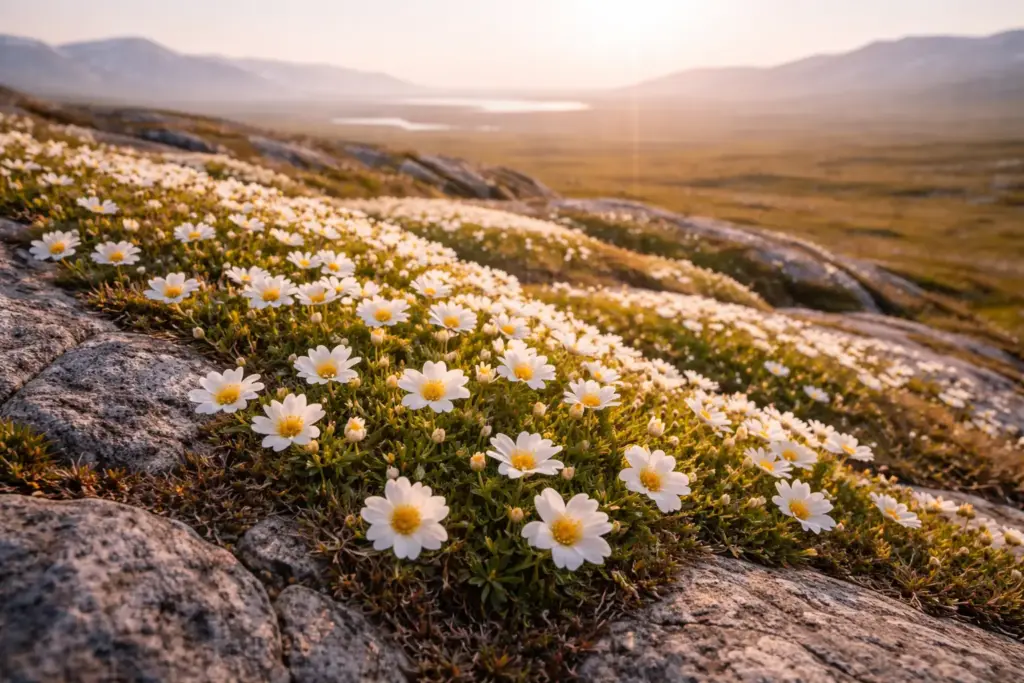
Moving further north and east, the dense boreal forests give way to the sprawling, treeless tundra. The Northwest Territories territorial flower survives in cryosols by restricting root systems to the permafrost active layer. Fierce, unabated winds and continuous 24-hour summer daylight dictate exactly which species can secure a foothold.
Northwest Territories Territorial Flower: The Mountain Avens (Dryas octopetala)
The northwest territories territorial flower isn’t tall or flashy. The Mountain Avens is a low-lying, creeping evergreen shrub that barely reaches 10 to 15 centimeters off the ground. By staying low, the Mountain Avens NWT avoids the destructive, moisture-stealing winds that shear across the flat plains.
Let’s look at how the three primary territorial blooms compare in their survival metrics:
| Feature | Fireweed (Yukon) | Mountain Avens (NWT) | Purple Saxifrage (Nunavut) |
| Typical Height | 50 cm – 250 cm | 5 cm – 15 cm | 3 cm – 5 cm |
| Primary Habitat | Post-fire boreal forest | Rocky, exposed tundra | High Arctic gravel/ice |
| Bloom Timing | Late July – August | Late June – July | May – Early June |
| Key Adaptation | High seed volume | Heliotropism (Sun tracking) | Extreme freeze tolerance |
Heliotropism in the Arctic: How the Mountain Avens Follows the Sun
Mountain Avens generates internal heat via heliotropism, utilizing white petals as parabolic solar concentrators.
How does a plant generate enough energy when the ambient air temperature hovers barely above freezing? It builds its own solar dish. The northwest territories territorial flower utilizes heliotropism, physically turning its white petals to track the sun as it circles the Arctic sky.
This tracking behavior provides massive, measurable biological advantages:
- Microclimate Heating: The parabolic shape of the petals reflects sunlight into the center of the flower, raising the internal temperature by 2°C to 5°C above the surrounding air.
- Pollinator Attraction: Insects like the Bombus polaris (Arctic bumblebee) actively seek out these heated flowers to warm their flight muscles.
- Accelerated Seed Maturation: The extra thermal energy reduces the seed development cycle from 45 days down to roughly 28 days, a vital shortcut before the snow returns.
The Significance of the “White Bloom” in NWT Heritage
The visual impact of the northwest territories territorial flower is deeply tied to the region’s identity. During peak summer, vast stretches of rocky ridges turn completely white, resembling a mid-summer snowfall. This blooming event serves as a reliable biological calendar for local indigenous communities, signaling the narrow window for specific summer foraging and hunting activities. It’s a precise environmental indicator.
The Edge of Existence: The Floral Symbol of Nunavut
The final and most extreme environment for any plant life lies in the rocky, ice-battered expanses of the northeast. The territorial flowers of Northern Canada found here aren’t just surviving the cold; they’re actively defying the limits of biology. The frost-free growing season here sometimes lasts less than 20 days.
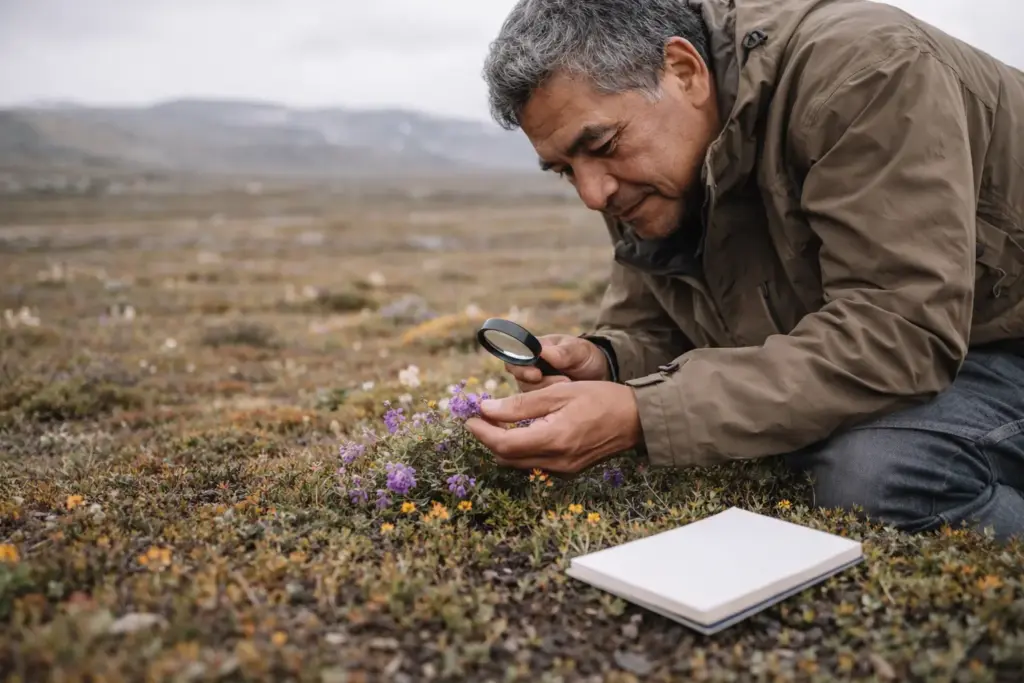
Join Canadian Museum of Nature researcher Paul Sokoloff on an expedition across the tundra as he identifies the resilient plant species that thrive in the extreme High Arctic environment.
Nunavut Territorial Flower: The Purple Saxifrage (Saxifraga oppositifolia)
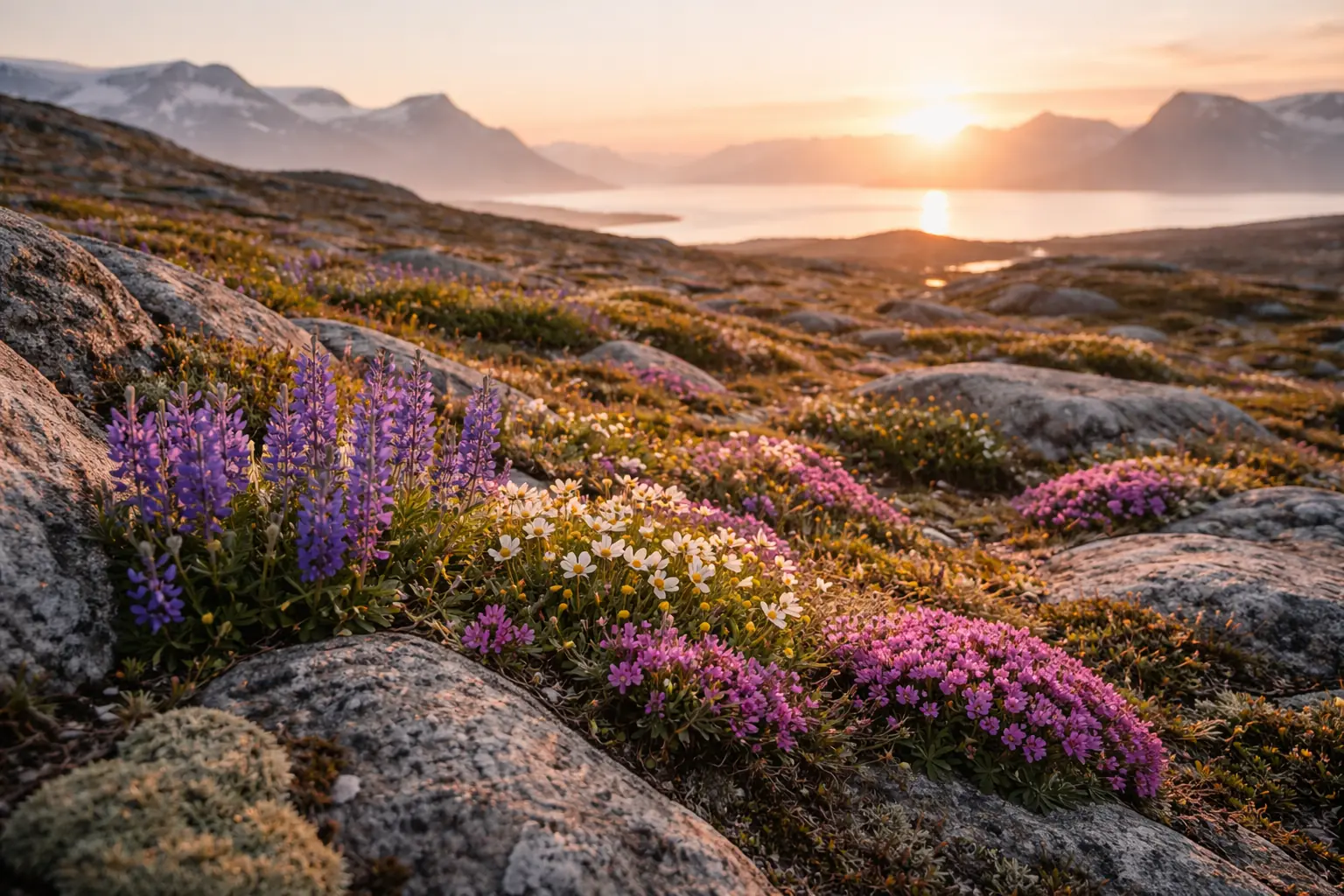
When you look at the nunavut territorial flower, you’re looking at one of the northernmost plant species on Earth. The Purple Saxifrage Nunavut grows in dense, tight cushions directly on gravel and bedrock. It’s a stunning example of the Arctic flora of Canada, producing incredibly vivid purple flowers that contrast violently against the gray and white landscape.
“You’ll find Saxifrage clinging to rocks where absolutely nothing else grows. It’s the ultimate pioneer, creating its own microscopic ecosystem on barren stone.” — Paul Sokoloff, Senior Research Assistant, Botany at the Canadian Museum of Nature
Blooming Against the Ice: The Hardiest Flower in Canada
Purple Saxifrage Nunavut replaces transpiration with controlled desiccation to prevent membrane rupture from ice crystals.
Just how tough is this plant? According to research from the Canadian Museum of Nature (2021, Ottawa, Canada), the tissues of the nunavut territorial flower can survive internal freezing down to -40°C without cellular rupture.
Molecular Defense: Dehydrins and AFP Proteins
To survive, the nunavut territorial flower utilizes Dehydrins—specialized proteins that stabilize cell membranes against desiccation. Alongside Antifreeze Proteins (AFP), these prevent the formation of lethal large-scale ice crystals within the cytoplasm, allowing the plant to remain “supercooled” but alive.
Inuktitut Names and Cultural Uses of the Purple Saxifrage
In Inuktitut, the nunavut territorial flower is known as Aupaluktunnguat. It isn’t just nice to look at; it has practical applications. Traditionally, the blooming of Aupaluktunnguat is highly anticipated, officially marking the arrival of spring. The early May bloom of the Nunavut territorial flower results from metabolic bud preparation in the preceding season.
Survival Strategies of Arctic Wildflowers
You can’t fully appreciate these plants without examining the specific mechanics of their biology. The territorial flowers of Northern Canada share several evolutionary tactics that allow them to endure conditions that would instantly kill temperate species. It’s a precise biological balancing act. These specialized survival tactics are part of a much larger story of Canadian native plant ecology that spans from the high Arctic to the southern temperate zones.
Adapting to Permafrost and 24-Hour Sunlight
How do you grow when the soil half a meter down is permanently frozen solid? You adapt your entire life cycle. The flora of the Far North follows a ruthless, highly optimized schedule.
Navigation of Cryosols and Active Layers
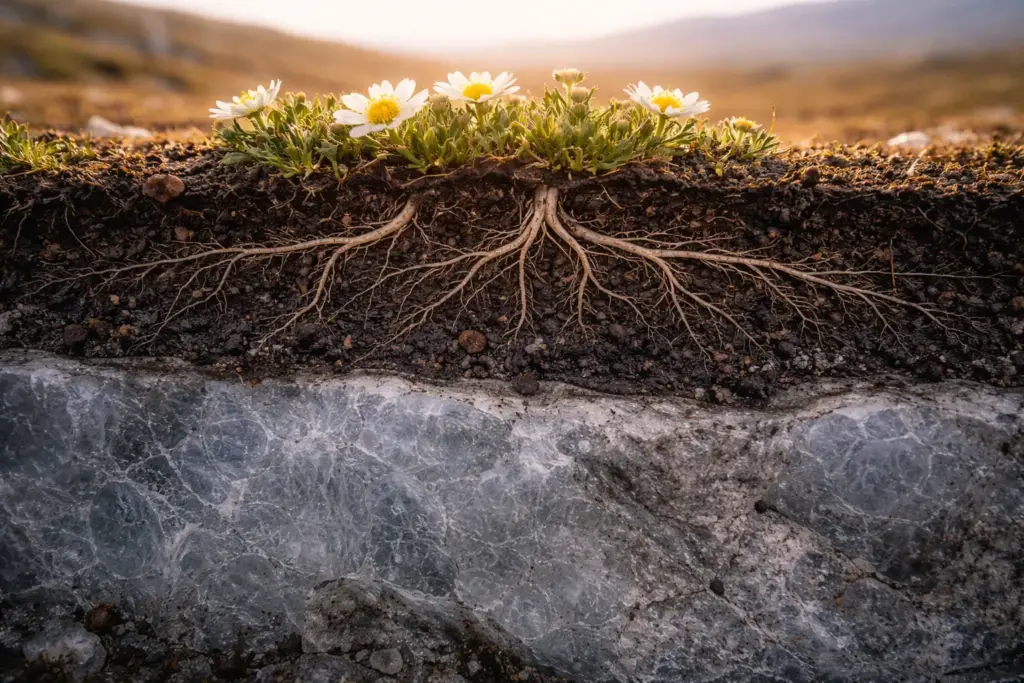
Arctic plants must root within Cryosols—soils affected by permafrost. They focus their growth in the “active layer,” the top 10-30 cm of soil that actually thaws. If a plant attempts to root deeper, it hits the permafrost table, leading to root death.
Here is the step-by-step biological action plan these plants execute during the brief summer:
- Break Surface Dormancy: Detect the first sustained soil surface temperatures above 0°C to initiate immediate sap flow.
- Deploy Shallow Root Systems: Spread roots laterally within the top 10 to 20 centimeters of soil, actively avoiding the impenetrable permafrost layer below.
- Maximize Photosynthesis: Utilize the 24-hour continuous daylight to photosynthesize around the clock, bypassing the normal nocturnal resting phase of southern plants.
- Halt Vegetative Growth Early: Stop producing new leaves by mid-July, shifting 100% of cellular energy into seed hardening.
- Trigger Dessication: Willingly dehydrate above-ground cellular tissues by late August to prevent ice crystal formation during the incoming deep freeze.
The Fragile Beauty: Why Northern Flora is Vulnerable to Climate Change
Northern floral vulnerability stems from the phenological gap between bloom timing and polar pollinator activity.
Despite their toughness, these plants face an existential threat. This hardiness is effective for extreme cold environments if the ecosystem remains stable. However, in the context of rapid Arctic warming, this may not work because southern invasive species are moving north. According to the University of British Columbia (2023, Vancouver, Canada), shifting phenology—the timing of biological events—is heavily disrupting tundra ecosystems.
The primary threats include:
- Shrubification: Taller, aggressive willows and birches are migrating north, physically shading out the low-lying territorial blooms.
- Pollinator Mismatch: Unusually warm springs cause flowers to bloom 10 to 14 days earlier than historical averages.
- Permafrost Thaw: Melting permafrost causes ground slumping and soil supersaturation, drowning root systems that are adapted to dry, well-drained rocky ridges.
Frequently Asked Questions About Northern Territorial Flowers
What is the most iconic flower of the Canadian North?
The yukon territorial flower—the Fireweed—is generally the most widely recognized globally due to its massive, highly visible swaths of pink along major northern highways.
Can Fireweed be found in other parts of Canada besides Yukon?
Yes, but you won’t see it in the same dominant concentrations. While the yukon territorial flower grows across many provinces, it typically only appears in small, scattered patches in southern regions. While Fireweed thrives in the North, you can explore how it differs from the diverse prairie and coastal blooms found in the neighboring western provinces.
How does the Purple Saxifrage survive temperatures below freezing?
It survives through cellular chemistry. The nunavut territorial flower accumulates heavy concentrations of carbohydrates and specialized proteins that prevent sharp ice crystals from forming.
Why is the Mountain Avens considered a pioneer species in the NWT?
It’s considered a pioneer because it physically alters the environment. The northwest territories territorial flower forms dense mats over bare gravel, creating a thin layer of topsoil for other plants.
Is it legal to collect seeds of territorial flowers in the Canadian Arctic?
No, unless you hold a specific scientific collection permit. The ecosystems supporting the northwest territories territorial flower and the nunavut territorial flower are incredibly fragile.
Planning a trip to witness these resilient wonders in person? Don’t leave your preparations to chance. Use our functional checklist to align your travel with the peak blooming windows and ensure you adhere to strict Arctic conservation protocols.

The territorial flowers of Northern Canada aren’t just pretty symbols for a flag; they’re highly optimized survival engines. From the fire-activated seeds of the Yukon to the ice-defying roots in Nunavut, these species prove that life can adapt to the most hostile environments on Earth. Understanding their biology gives us a profound respect for the fragile, yet resilient, ecosystems of the true North. To truly appreciate the territorial flowers of Northern Canada, one must look past their petals and into their complex molecular resilience.
Sources
- Canadian Museum of Nature (2021, Ottawa, Canada). Cryobiology and Freeze Tolerance in High Arctic Saxifraga.
- University of British Columbia (2023, Vancouver, Canada). Phenological Shifts and Shrubification in Sub-Arctic Tundra Ecosystems.
- Yukon Government Department of Environment (2024, Whitehorse, Canada). Post-Wildfire Succession and Chamaenerion angustifolium Regeneration Rates.
- Dr. Susan Aiken. Former Research Scientist, Botany.
- Paul Sokoloff. Senior Research Assistant, Botany, Canadian Museum of Nature.