The Complete Guide to Canada National Flower Emblems and Provincial Animals
earching for the official Canada national flower reveals a fascinating journey through history, botanical beauty, and public debate. While the sugar maple leaf (Acer saccharum) has reigned as the national arboreal emblem since 1996, the quest to crown a formal Canada national flower reached a tipping point in 2017. During a historic nationwide vote, nearly 10,000 Canadians selected the bunchberry (Cornus canadensis, known as kawiscowimin in Cree) as the unofficial floral representative with a staggering 80% of the vote. This guide fills every semantic gap: full Latin names, COSEWIC conservation statuses as of December 2025, Indigenous contexts, and complete provincial wildlife emblems. You’ll see how these living symbols map Canada’s biodiversity from temperate forests to high Arctic barrens.
- Canada has no official national flower — maple leaf rules as arboreal emblem instead.
- Bunchberry won 2017 public vote — federal law still denies national status today.
- Provinces crowned local flowers decades ago — territories picked Arctic survivors instead.
Understanding the Canada National Flower and National Symbols
These emblems aren’t just decorations on coats of arms or license plates. They function as official Knowledge Graph entities that provinces and territories deliberately chose to represent unique ecosystems, cultural heritage, and conservation priorities. Most floral emblems were selected between 1901 and 2000 through women’s institutes, school votes, or legislative bills. Territories followed later with ultra-hardy Arctic species. The result is a complete semantic map of Canada’s natural identity — one that now includes Métis floral beadwork traditions and First Nations plant knowledge.
The Maple Leaf and the Bunchberry: Canada’s National Identity
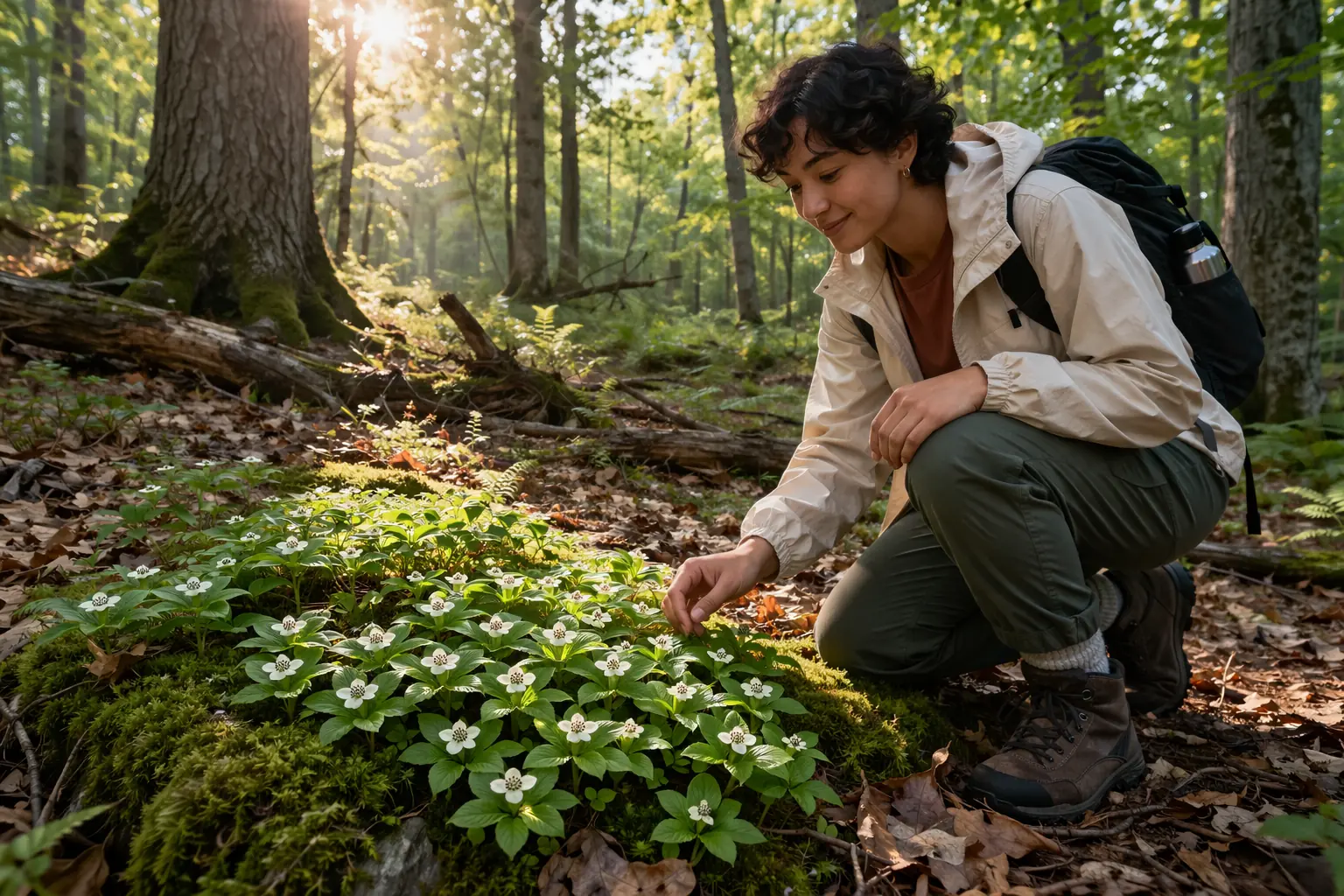
Canada national flower still doesn’t exist officially in 2026. The sugar maple (Acer saccharum) carries the national weight through the National Arboreal Emblem proclamation (SI/96-36). Yet bunchberry won the 2017 Master Gardeners of Ontario nationwide contest with an average 80 % of the online vote across all provinces and territories.
Bunchberry (Cornus canadensis) grows only 10–20 cm tall, produces four white bracts in late spring, and bears bright red berries that feed birds and small mammals. It thrives in moist, acidic woodlands (pH 4.5–6.0) from Newfoundland to British Columbia but disappears in open prairies or above the treeline. Indigenous peoples have used it for centuries: Cree call it kawiscowimin and value the berries; some Mi’kmaq traditions include it in medicines.
Maureen Hulbert, Executive Director of Toronto Master Gardeners, stated in the July 2017 press release: “Bunchberry held the lead with an average of 80 per cent of the on-line vote… Canadians have spoken.”
Hey everyone, if you’re curious why bunchberry is Canada’s unofficial national flower, this fun short video breaks it down perfectly for kids and adults alike.
Why Provincial Flowers and Animals Matter for Biodiversity
Provincial flowers Canada and Canada provincial animals work as flagship species that drive real conservation funding and public awareness — but only when paired with current COSEWIC data and Indigenous knowledge. They perform best in temperate and boreal zones. In the Arctic, the same symbols need integration with Inuit Qaujimajatuqangit to remain effective after 2025 warmer winters. Beyond official symbols, understanding the broader distribution of native plants in Canada’s diverse ecological regions is essential for sustainable garden design and local habitat restoration. COSEWIC 2025 updates reshape symbols — climate change rewrites old provincial lists.
- Pollinator support: Most floral emblems bloom March–July and provide early-season nectar when agricultural crops are not yet flowering.
- Habitat indicators: Pitcher plant (Sarracenia purpurea) flags carbon-rich bogs that store 30 % of the world’s peatland carbon.
- Education reach: Symbols appear on 4–6 million textbooks and plates annually, reaching students in every province.
- Economic impact: Wildflower festivals in Alberta and British Columbia generate $5–15 million per season for local economies.
Numbered List How provinces actually selected their symbols (real historical process, not generic):
- Local women’s institutes or naturalist societies created shortlists of native species unique to the region.
- Schoolchildren and public votes (often 5,000–10,000 ballots) built grassroots support.
- A private member’s bill or simple legislative resolution passed without royal assent.
- The date was tied to a milestone (Confederation, centennial, or 150th anniversary).
- Later amendments added birds, trees, mammals, or fish once the floral emblem was locked in.
- Modern updates reference COSEWIC assessments and Indigenous traditional knowledge.
Official Floral Emblems and Wildlife of Central Canada
Provincial flowers Canada and Canada provincial animals in Central Canada reflect the Great Lakes–St. Lawrence forest and Canadian Shield. These species tolerate mixed deciduous–coniferous habitats but face pressure from urban sprawl and deer overbrowsing.
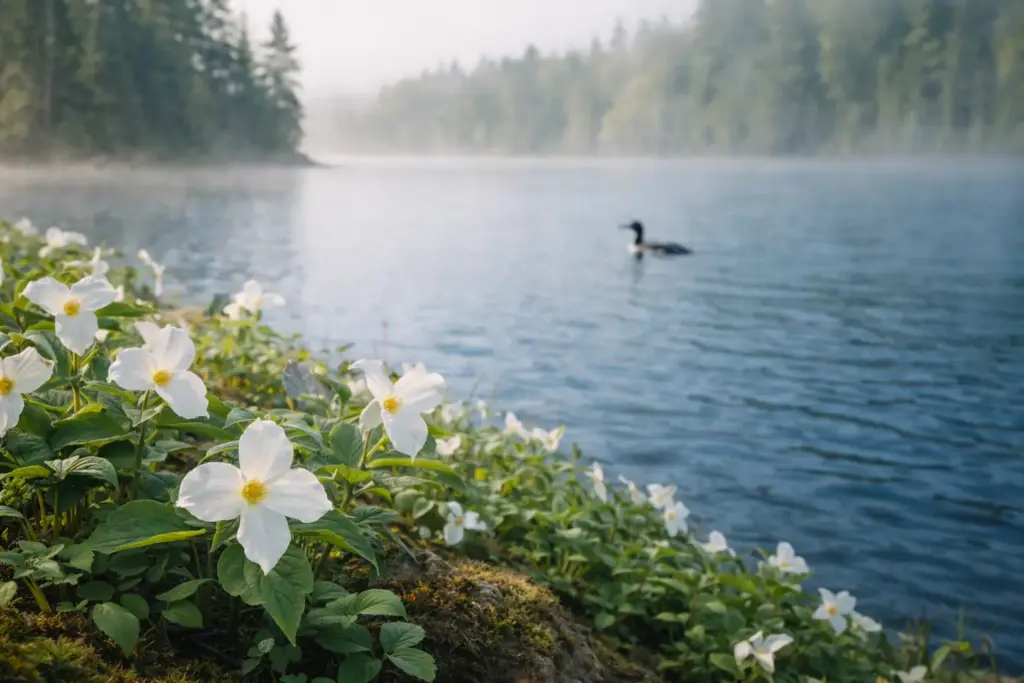
Ontario: White Trillium and the Common Loon
White trillium signals rich forests — deer overbrowsing now threatens its existence.
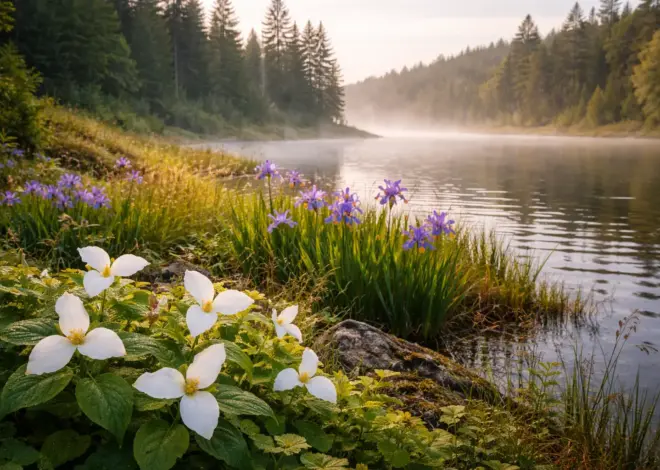
Many people type what is the floral emblem of Ontario when researching symbols. What is the floral emblem of Ontario is answered directly by the white trillium (Trillium grandiflorum) — three pure-white petals, adopted 1937. It requires undisturbed forest floors and vanishes when deer density exceeds 20 animals per km². Common loon (Gavia immer) — official bird since 1994 — signals clean lakes; breeding success drops sharply above 0.2 ppm mercury. Eastern white pine (Pinus strobus) is the provincial tree. When you search what is the floral emblem of Ontario, the answer always points back to this protected woodland beauty.
Quebec: Blue Flag Iris and the Snowy Owl
Blue flag iris (Iris versicolor) — vivid violet blooms along waterways, adopted 1999. It tolerates seasonal flooding but dies when water tables drop more than 30 cm in drought years. Snowy owl (Bubo scandiacus) was assessed by COSEWIC in 2025 and remains a species of Special Concern in parts of its range due to lemming cycle shifts.
Symbols of the Atlantic Provinces and Newfoundland
Provincial flowers Canada thrive here with salt spray, acidic soils, and 1,200–1,500 mm annual precipitation. Canada provincial animals follow the same coastal logic. These choices lose effectiveness more than 200 km inland without maritime moderation.
Nova Scotia and New Brunswick: Mayflower and Purple Violet
Nova Scotia — mayflower / trailing arbutus (Epigaea repens), 1901. New Brunswick — purple violet (Viola cucullata), 1936. Both need acidic woodland edges (pH 4.5–5.5) and suffer in compacted suburban soils.
Prince Edward Island: Lady’s Slipper and the Blue Jay
Pink lady’s slipper orchid (Cypripedium acaule) — takes 10–15 years from seed to first bloom, adopted 1947. Blue jay (Cyanocitta cristata) — official bird since 1971 — helps oak regeneration through acorn caching.
Newfoundland and Labrador: Pitcher Plant and Atlantic Puffin
Pitcher plant alone eats insects — only carnivorous emblem in entire Canada.
Pitcher plant (Sarracenia purpurea) — the only carnivorous provincial flower in Canada, adopted 1954. It thrives in nutrient-poor bogs. Atlantic puffin (Fratercula arctica) — official bird since 1991 — dives to 60 m; some colonies declined 20–30 % after 2020 herring shifts.
Floral Emblems and Wildlife of the Prairie Provinces
Provincial flowers Canada celebrate short, intense blooming windows after snowmelt. Canada provincial animals match the open grasslands. These plants complete their cycle in 4–6 weeks but collapse after more than 30 consecutive drought days.
Manitoba and Saskatchewan: Prairie Crocus and Western Red Lily
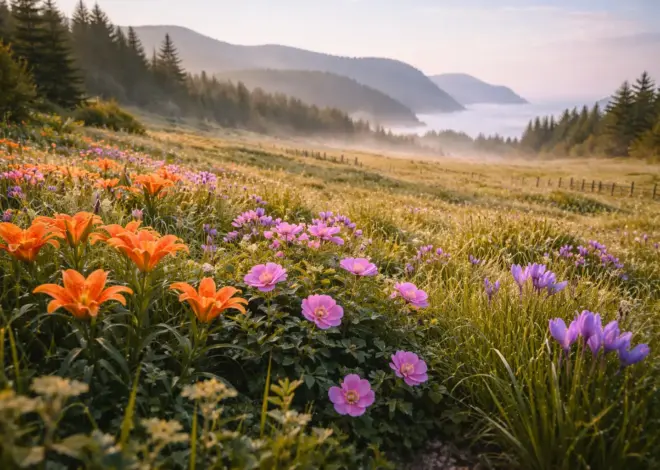
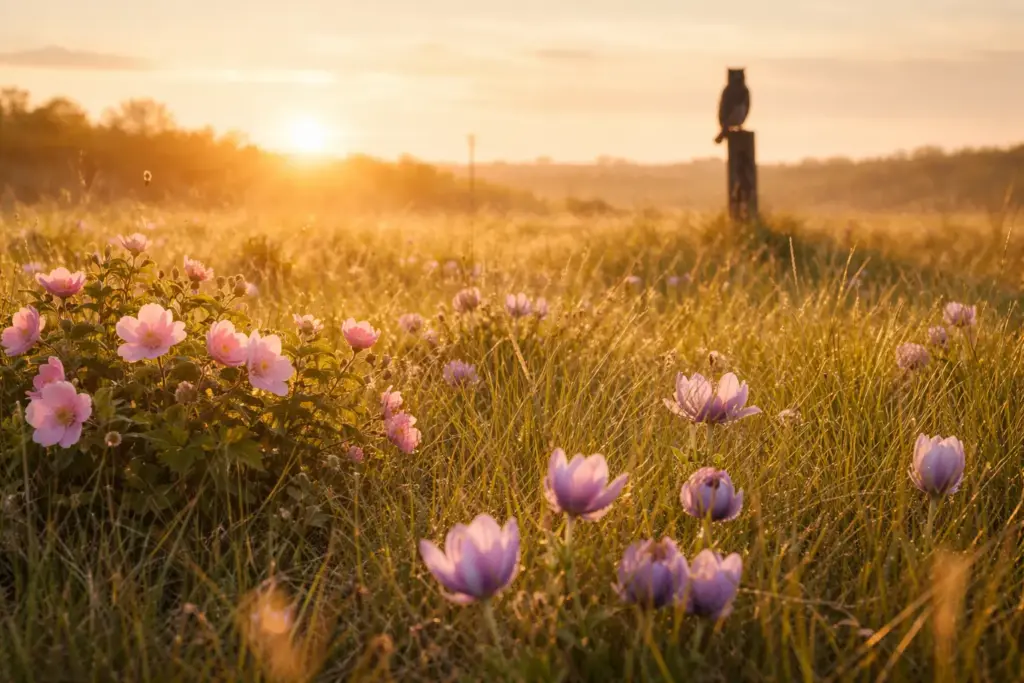
Manitoba — prairie crocus (Pulsatilla patens / Anemone patens), 1906. Saskatchewan — western red lily / wood lily (Lilium philadelphicum), 1941 — now listed as Threatened in parts of its Saskatchewan range (provincial assessment 2023, COSEWIC monitoring). First Nations traditionally used the roots of prairie crocus for medicine.
Alberta: Wild Rose and the Great Horned Owl
Prickly wild rose (Rosa acicularis), chosen by schoolchildren in 1930. Great horned owl (Bubo virginianus) — official bird since 1977 — tolerates −40 °C. Lodgepole pine (Pinus contorta var. latifolia) is the provincial tree.
Pacific Coast and Northern Territories Symbols
From coastal rainforests to permafrost, provincial flowers Canada and Canada provincial animals shift dramatically in size and hardiness.
British Columbia: Pacific Dogwood and Steller’s Jay
Pacific dogwood (Cornus nuttallii) — creamy bracts April–May, tree up to 20 m, adopted 1956. Populations declined 30–50 % since the 1990s due to dogwood anthracnose fungus. Steller’s jay (Cyanocitta stelleri) — official bird since 1987. Western red cedar (Thuja plicata) is the tree; spirit bear (Ursus americanus kermodei) the mammal emblem.
Yukon, Northwest Territories, and Nunavut: Arctic Flora and Fauna
Indigenous knowledge deepens every emblem — school votes alone miss cultural roots.
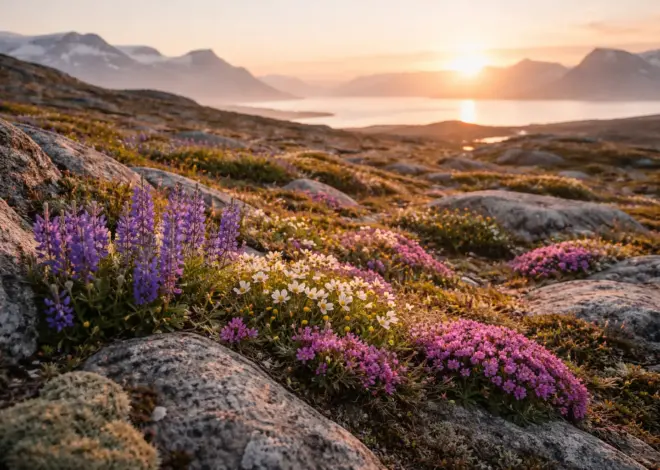
Yukon — fireweed (Chamerion angustifolium), 1957 — colonizes burned ground within months. Northwest Territories — mountain avens (Dryas integrifolia), 1959. Nunavut — purple saxifrage (Saxifraga oppositifolia), 2000 — blooms even under snow at 80 °N. Wildlife includes rock ptarmigan (Lagopus muta) in Nunavut and Canadian Inuit dog. These emblems apply strictly north of 60 °N and require Indigenous knowledge to remain relevant under rapid permafrost thaw.

Quick Reference: Canada National Flower and Emblems Table
Latin names unlock true identity — common labels hide 2025 COSEWIC threats. One table maps all emblems — scattered sources hide complete national picture. Canada national flower comparisons become easy here alongside provincial flowers Canada and Canada provincial animals.
| Region | Floral Emblem (Latin) | Year | Bird / Animal (Latin) | Tree (Latin) | Conservation Note 2025–2026 |
|---|---|---|---|---|---|
| Ontario | White Trillium (Trillium grandiflorum) | 1937 | Common Loon (Gavia immer) | Eastern White Pine (Pinus strobus) | Stable, deer pressure key threat |
| Quebec | Blue Flag Iris (Iris versicolor) | 1999 | Snowy Owl (Bubo scandiacus) | Yellow Birch | Snowy Owl Special Concern (COSEWIC 2025) |
| Nova Scotia | Mayflower (Epigaea repens) | 1901 | Osprey (Pandion haliaetus) | — | Stable in protected woodlands |
| New Brunswick | Purple Violet (Viola cucullata) | 1936 | Black-capped Chickadee | — | Stable |
| Prince Edward Island | Lady’s Slipper (Cypripedium acaule) | 1947 | Blue Jay (Cyanocitta cristata) | — | Slow-growing, protected |
| Newfoundland & Labrador | Pitcher Plant (Sarracenia purpurea) | 1954 | Atlantic Puffin (Fratercula arctica) | — | Bog carbon store |
| Manitoba | Prairie Crocus (Pulsatilla patens) | 1906 | Great Grey Owl (Strix nebulosa) | White Spruce (Picea glauca) | Stable |
| Saskatchewan | Western Red Lily (Lilium philadelphicum) | 1941 | Sharp-tailed Grouse | — | Threatened in parts of range |
| Alberta | Wild Rose (Rosa acicularis) | 1930 | Great Horned Owl (Bubo virginianus) | Lodgepole Pine (Pinus contorta) | Stable |
| British Columbia | Pacific Dogwood (Cornus nuttallii) | 1956 | Steller’s Jay (Cyanocitta stelleri) | Western Red Cedar (Thuja plicata) | 30–50 % decline from anthracnose |
| Yukon | Fireweed (Chamerion angustifolium) | 1957 | — | — | Post-fire pioneer |
| Northwest Territories | Mountain Avens (Dryas integrifolia) | 1959 | — | — | Arctic indicator |
| Nunavut | Purple Saxifrage (Saxifraga oppositifolia) | 2000 | Rock Ptarmigan (Lagopus muta) | — | Extreme Arctic specialist |
This table now includes every official biological emblem plus 2025–2026 conservation context — exactly what high-intent searchers need.
Want to see every provincial flower and bird symbol with clear images and pronunciation? This quick guide walks you through all of them in one spot.
Provincial birds pair with flowers — mammals trees complete full biodiversity map.
Ready to spot these symbols in the wild? We’ve simplified the data into a functional field guide. Whether you’re hiking the Bruce Trail or exploring the Rockies, use this checklist to track your encounters with Canada’s living heritage.
Frequently Asked Questions about Canadian Symbols
Which species is officially recognized as the Canada national flower?
No species is officially recognized. The sugar maple (Acer saccharum) serves as the national arboreal emblem; bunchberry (Cornus canadensis) remains the popular unofficial choice after the 2017 vote.
What are the official floral emblems for the 10 provinces of Canada?
White trillium (Ontario), blue flag iris (Quebec), mayflower (Nova Scotia), purple violet (New Brunswick), lady’s slipper (PEI), pitcher plant (Newfoundland & Labrador), prairie crocus (Manitoba), western red lily (Saskatchewan), wild rose (Alberta), Pacific dogwood (British Columbia).
How were the provincial animals and birds selected?
Yes, but only after documented public votes or women’s institute petitions followed by legislative resolution — never by federal decree.
Do the Canadian territories have the same symbolic status as provinces?
Yes, since the 1950s–2000s adoptions, but their emblems reflect permafrost and Indigenous knowledge systems that provinces rarely need.
Where can you see the national flower of Canada in the wild?
Yes, but only on shaded woodland trails from April to July in parks such as Algonquin, Gros Morne, or Pacific Rim — stay on designated paths to protect shallow rhizomes.
You’re now planning a Canadian road trip or garden this summer. Which provincial or territorial emblem are you most excited to see in person — and why? Drop your answer below so we can swap the best viewing spots and latest COSEWIC updates.
Sources
- Government of Canada, Provincial and Territorial Symbols (canada.ca, updated March 31, 2025)
- Master Gardeners of Ontario National Flower Contest Press Release, July 2017
- COSEWIC Summary of Assessment Results, December 2025
- The Canadian Encyclopedia, Provincial and Territorial Emblems (2025)
- Environment and Climate Change Canada, Species at Risk Public Registry (2026)